- 01
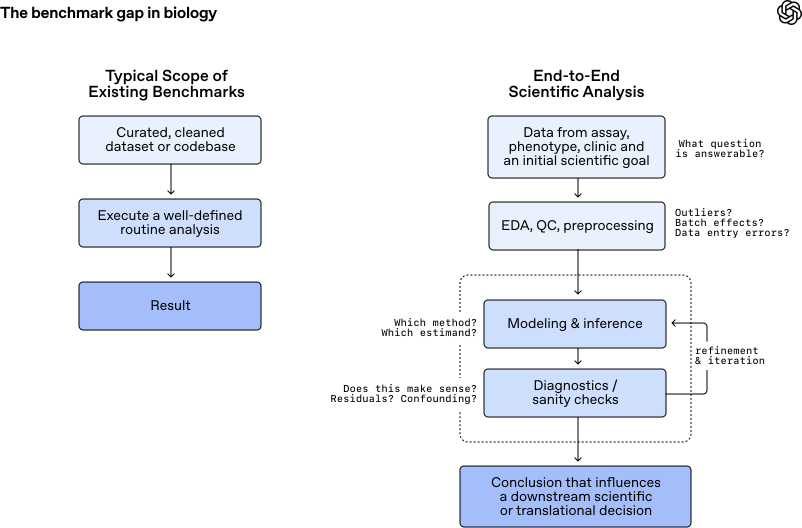 Introducing GeneBench-ProDataset construction Dataset construction Evaluation and grading Results Table of contents Dataset construction Evaluation and grading Results Scientific data rarely arrive with instructions. Researchers must decide whether a pattern reflects biology or noise, whether the data can support the question being asked, and how each result should change what they do next. AI agents are increasingly capable of executing complex analyses, but real scientific research also depends not simply on recalling
 - 02
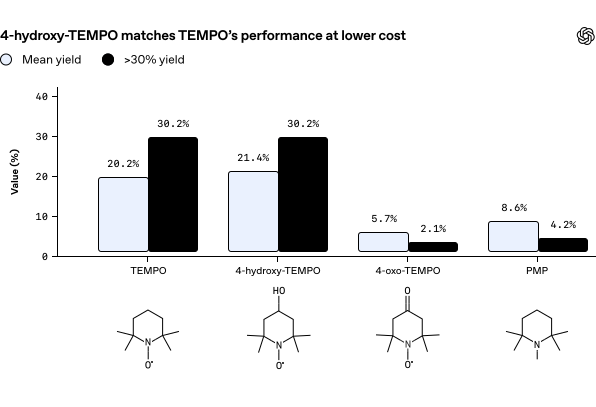 A near-autonomous AI chemist improves a challenging reaction in medicinal chemistryWhy the chemistry problem matters Why the chemistry problem matters Connecting GPT-5.4 to Maria AI and Lab What we found Limitations Preparedness What's next Table of contents Why the chemistry problem matters Connecting GPT-5.4 to Maria AI and Lab What we found Limitations Preparedness What's next OpenAI’s work in science is motivated by a simple belief: advanced AI can become a powerful partner for scientists, helping them explore more ideas, connect distant concepts, design better experiments
 - 03
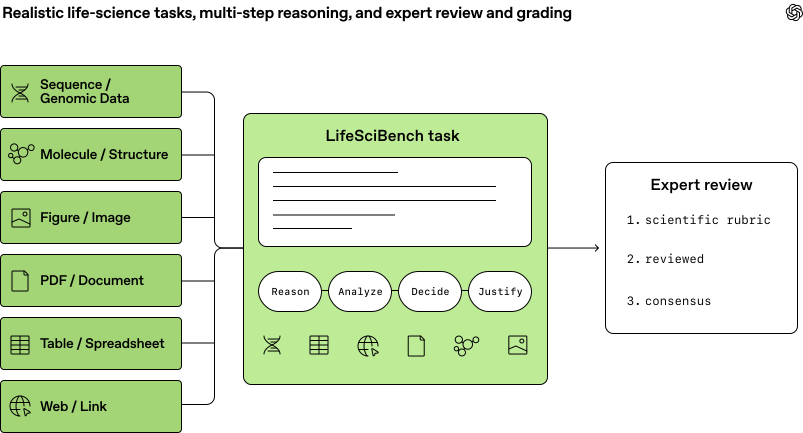 Introducing LifeSciBenchAgentic AI systems are becoming increasingly capable of performing scientific tasks. However, their usefulness to life science researchers depends on how well they handle the complexity of real research. That work rarely looks like a single fact-recall question or a clean prediction problem. Researchers interpret incomplete evidence, reconcile conflicting results, design difficult experiments, troubleshoot assays, evaluate translational risk, and decide what to do next under uncertainty. Current
 - 04
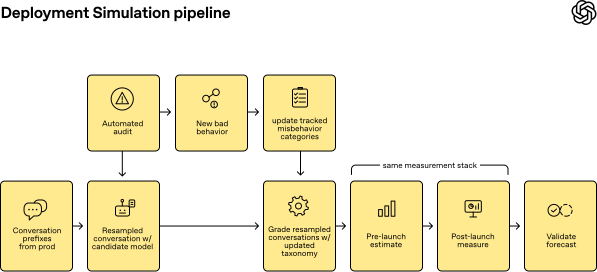 Predicting model behavior before release by simulating deploymentIntroduction Introduction How Deployment Simulation works How we tested Deployment Simulation Deployment Simulation significantly expands pre-deployment risk assessment Reducing evaluation awareness Tool simulation for agentic trajectories WildChat and external auditing Limitations Conclusion Table of contents Introduction How Deployment Simulation works How we tested Deployment Simulation Deployment Simulation significantly expands pre-deployment risk assessment Reducing evaluation awareness To
 - 05
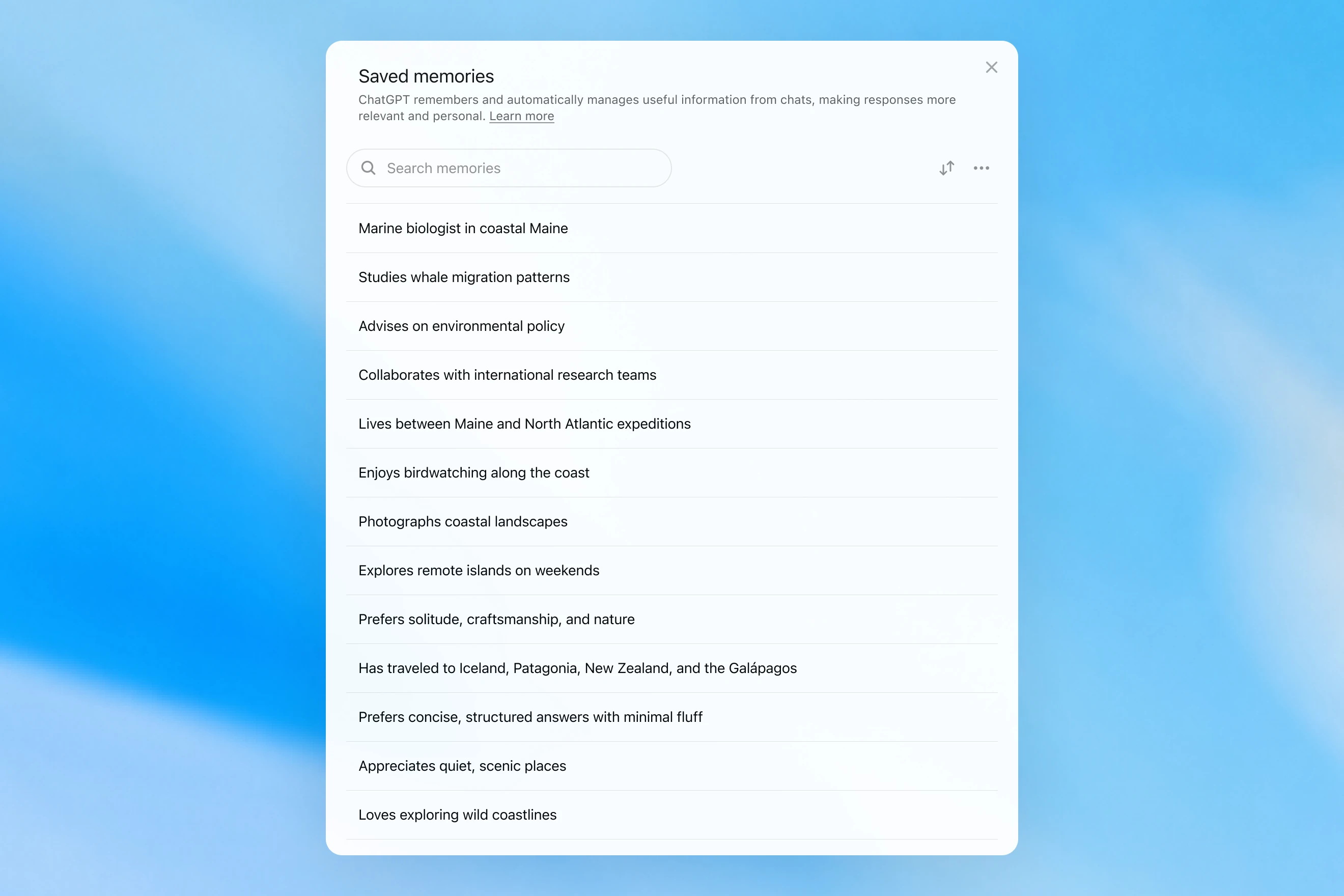 Dreaming: Better memory for a more helpful ChatGPTHow memory has evolved How memory has evolved How we evaluate memory Carrying forward context Following preferences Staying current over time A more scalable foundation for the future Table of contents How memory has evolved How we evaluate memory Carrying forward context Following preferences Staying current over time A more scalable foundation for the future Today we’re beginning to roll out a more capable and scalable system for synthesizing memory, developed to tackle the staleness, correctn
 - 06
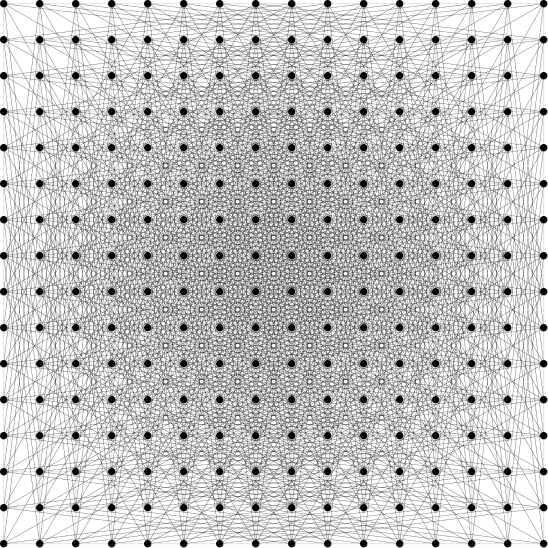 An OpenAI model has disproved a central conjecture in discrete geometryThe unit distance problem The unit distance problem New techniques from algebraic number theory What this means for mathematics Why this matters Table of contents The unit distance problem New techniques from algebraic number theory What this means for mathematics Why this matters For nearly 80 years, mathematicians have studied a deceptively simple question: if you place n n n points in the plane, how many pairs of points can be exactly distance 1 1 1 apart? This is the planar unit distance pro
 - 07What Parameter Golf taught us about AI-assisted researchTechnical impressions Technical impressions Record track Nonrecord track Takeaways What’s next? Table of contents Technical impressions Record track Nonrecord track Takeaways What’s next? We launched Parameter Golf to engage and support the machine learning research community in exploring a new, tightly constrained machine learning problem. We wanted the challenge to be interesting enough to reward real technical creativity, while remaining conceptually simple and easy to verify. Participants ha
- 08Introducing OpenAI Privacy FilterA small model with frontier personal data detection capability A small model with frontier personal data detection capability Model overview How we built it How Privacy Filter performs Limitations Availability Looking ahead Table of contents A small model with frontier personal data detection capability Model overview How we built it How Privacy Filter performs Limitations Availability Looking ahead Today we’re releasing OpenAI Privacy Filter, an open-weight model for detecting and redacting per
- 09
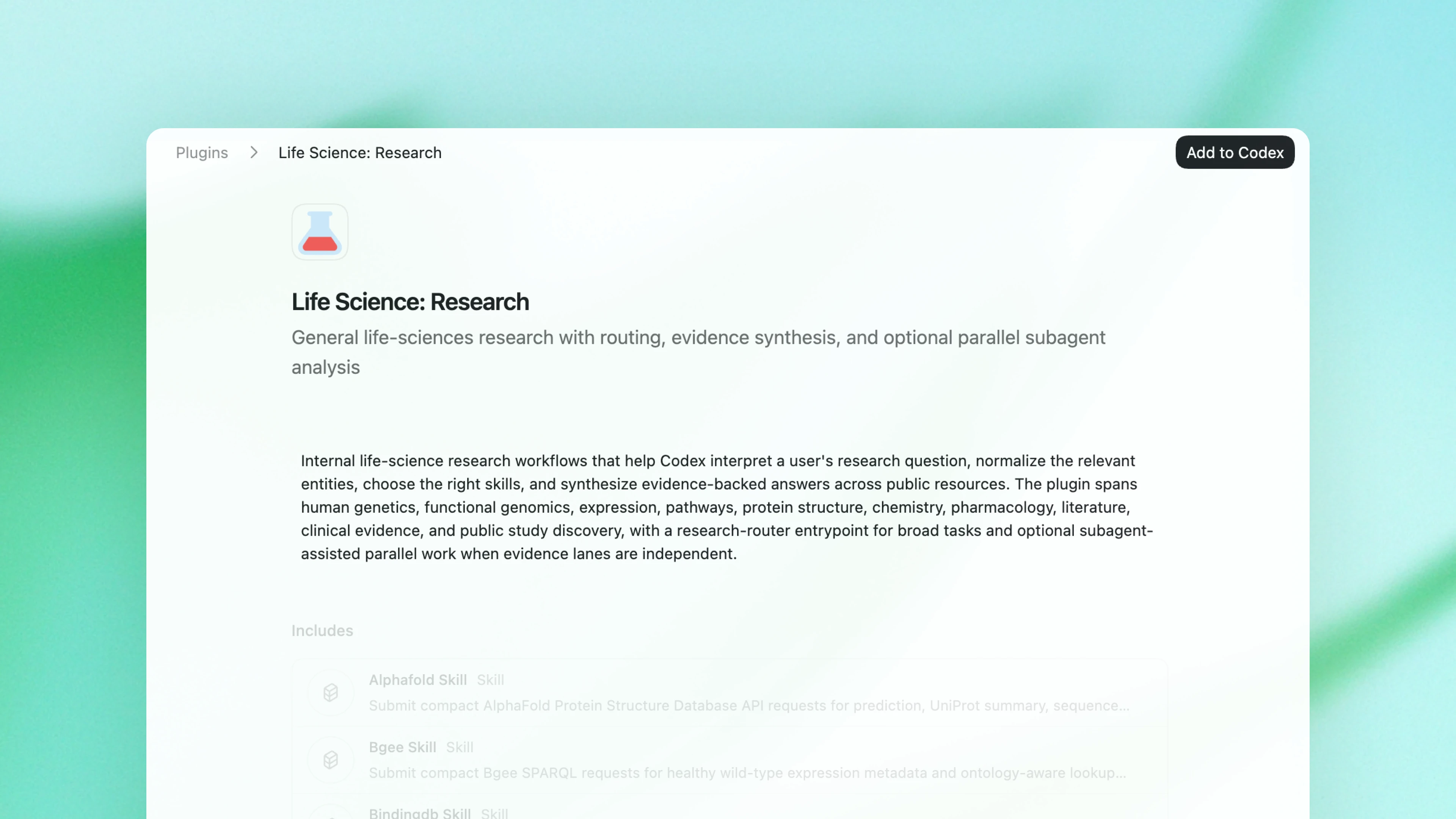 Introducing GPT-Rosalind for life sciences researchBuilt for scientific workflows Built for scientific workflows Customers and ecosystem Performance and evaluation Industry evaluations Connecting to the tools scientists use Trusted access Getting started What’s next Table of contents Built for scientific workflows Customers and ecosystem Performance and evaluation Industry evaluations Connecting to the tools scientists use Trusted access Getting started What’s next Today, we’re introducing GPT‑Rosalind, our frontier reasoning model built to supp
 - 10Inside our approach to the Model SpecA public framework for model behavior A public framework for model behavior What’s in the Model Spec High-level intent and public commitments The Chain of Command Interpretive aids: decision rubrics and concrete examples What the Model Spec is not How we arrived at this structure Why do we put things in the Model Spec? Shouldn’t advanced AI be able to figure this out on its own? How we write and implement the Model Spec Being realistically aspirational Who contributes (and why that matters) How
 哔哩哔哩
哔哩哔哩 新浪新闻
新浪新闻 新浪
新浪 GitHub
 CSDN
CSDN IT之家
IT之家 36氪
36氪 AcFun
AcFun 酷安Crowd Supply
 51CTO
51CTO 数字尾巴
数字尾巴 极客公园
极客公园 Hacker News
 HelloGitHub
 Hostloc
 虎嗅
虎嗅 爱范儿
爱范儿 稀土掘金
稀土掘金 Linux.doLobsters
 NodeSeek牛客OpenAI News36Kr Latest9to5MacAdafruit BlogAnt Bailing Developer BlogAnthropic EngineeringAnthropic NewsAnthropic Research小众软件Apple Machine Learning ResearchApple NewsroomAppleInsiderArs TechnicaBerkeley AI ResearchBD Tech TalksBerkeley RDIBoston Dynamics BlogByteDance Seed ResearchClaude BlogClaude Code ReleasesCloudflare BlogCMU Machine Learning BlogCSS-TricksCult of MacCursor BlogDaring FireballDario AmodeiDeepLearning.AI · The BatchGoogle DeepMind BlogDeepSeek GitHubDescript BlogDEV.toDwarkesh PatelEleutherAI BlogEngadgetEngadget · RoboticsFreebuf · 网络安全freeCodeCampGary MarcusGitHub BlogGitHub TrendingGitHub Trending · WeeklyGizmodoGoogle AI BlogGoogle Developers BlogGoogle Research BlogHackadayHugging Face BlogHugging Face · Daily PapersIEEE Spectrum RoboticsinclusionAIIndie HackersInfoQInterconnectsIT之家 · 24h 热榜Juejin HotAndrej KarpathyKickstarter · TechnologyMoonshot AI KimiLatent SpaceLil'Log (Lilian Weng)LiliputingLMSYS BlogLWN.netMacRumorsMake: MagazineMeituan LongCatMeta AI BlogMeta EngineeringMidjourney UpdatesMiniMaxMIT News · RoboticsMIT Technology ReviewMIT Tech Review · AIMozilla.ai BlogNew Atlas · RoboticsNVIDIA AI Blog
OpenAI Research · 实时热榜
- 01
- 02
- 03
- 04
- 05
- 06
- 07
- 08
- 09
- 10