





























































































HISTORY近 30 天历史柱高表示当天去重热搜数量
09/08—10/07 有历史数据
- 01
 Trading a Cloud Identity for Your Own: Workload Attestation on Managed ComputeBy Dhruv Pratap Introduction Organizations that have been around for a while usually run two identity systems side by side. One belongs to the cloud provider: IAM roles, instance profiles, execution roles. The other is your own, and it is the one your internal services actually check when they decide whether to answer a request. On infrastructure you build yourself, you can bootstrap your own identity however you like. On managed compute you cannot. The provider hands your process a cloud identiNetflix Technology Blog
 - 02
 Netflix Stratum Media Processing: Automated Container Right-SizingBy Violetta Pidvolotska and Naveen Mareddy Stratum is Netflix’s internal serverless media processing platform, shaped by over a decade of experience developing large-scale distributed systems. It powers a wide range of media workloads — including encoding, packaging, inspection, and quality scoring — behind playback, advertising, studio workflows, AI embeddings, and more. Engineers develop Stratum functions by packaging application code and OS dependencies into OCI images. Stratum then schedulesNetflix Technology Blog
 - 03
 Leave the Class Path in the Rearview MirrorIntroducing composable, module system native and agent friendly command line tools for modern Java development By Danny Thomas, JVM Ecosystem Team Recent work on the Java language to pave the on-ramp has made it easier than ever to start a Java program and evolve it using the full language and platform. At the end of that on-ramp lies Java’s mature build and dependency management ecosystem, capable of carrying software to enormous scale and complexity. That ecosystem reached its maturity by deveNetflix Technology Blog
 - 04
 The Lifecycle of LLM-as-a-Judge: Building, Aligning, and Monitoring at scaleBy Emma Yanyang Kong , JJ Tan , Ishan Gupta , Lars Olds , Claire Campbell , David Fagnan , Ratna Kavuri , Rohan Gosain , Veli Balin , Minsu Jang , Louis Garcia Introduction Any team generating text with an LLM at scale hits the same problem. You cannot evaluate everything manually. You don't know which outputs are great, which are mediocre, and which are harmful, because you simply cannot read them all. The standard solution is LLM-as-a-Judge , a second model that scores the first model’s outputNetflix Technology Blog
 - 05
 Running Apache Spark experiments in my sleep (and on a plane)By Prashanth Gedde Narayanaswamy As one of Netflix’s largest and critical data pipelines, member-sessionizer consolidates tens of billions of hourly client events, encompassing user taps, playbacks, and engagement signals, into individual viewing sessions per profile. A quick two-week tuning effort spiraled into two months when standard approaches hit a wall. Because the failures only happened at full production scale, each test took hours, limiting me to just three or four attempts daily. The tNetflix Technology Blog
 - 06
 MAPS: Netflix’s Multimodal Asset Personalization at ScaleBy Emma Yanyang Kong , Aditya Deshpande , Asad Abbasi , Bowei Yan , David Fagnan , Ashish Rastogi , Dhaval Patel , Ray Zhang Introduction The Netflix experience is a journey of discovery. Every visual cue, from the artwork on a title to the video previews that autoplay while you browse, is there to connect you with a story you will love. We call these visual cues assets , and choosing the right one for each member is a personalization problem of its own. But which image or video preview of SquidNetflix Technology Blog
 - 07
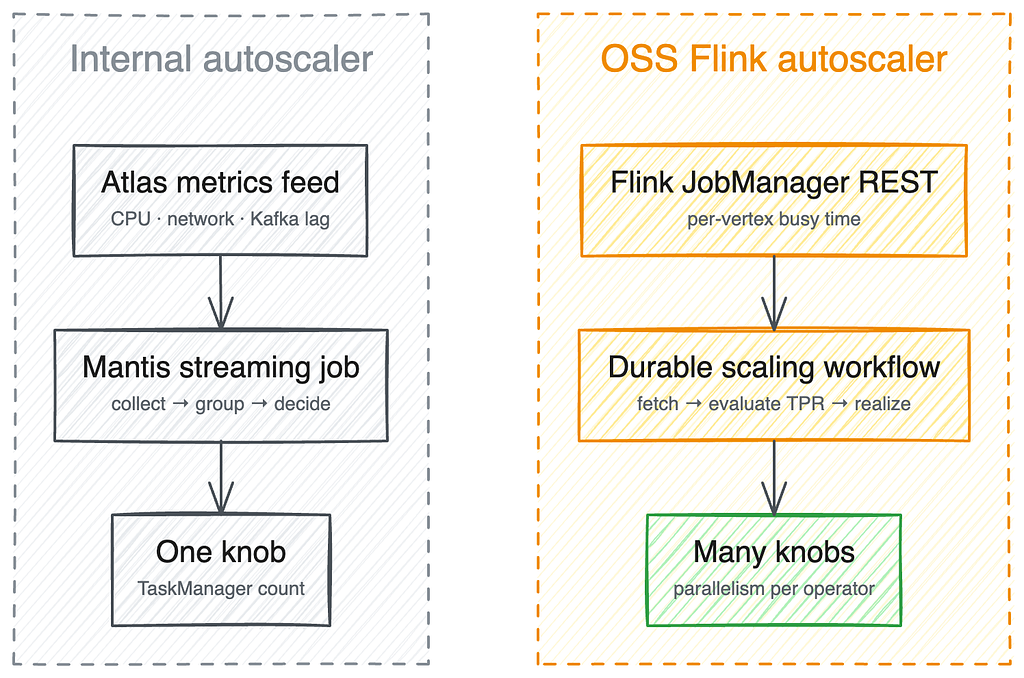 A Tale of Two Flink AutoscalersSamuel Yeboah , Francesco Di Chiara and Mingliang Liu Today, Netflix runs two Flink autoscalers. That is exactly one more than we want. We built the first one in-house years ago, when there was no mature option suited to our platform. The second came from the Apache Flink community, and it can scale workloads our homegrown system was never designed for. We now run both in production and are steadily converging on the open-source one. Along the way we learned some hard lessons about metrics, costNetflix Technology Blog
 - 08
 Netflix Conductor: The Next ChapterNetflix Conductor : The Next Chapter by Aravindan Ramkumar on behalf of the Conductor team Conductor is the workflow orchestration engine Netflix uses to stitch micro-services into reliable, observable business processes. If you’ve followed Conductor from the outside, the last thing you heard was probably the note on its GitHub repository : Netflix discontinued maintenance of Conductor OSS to refocus its resources on the internal fork. That announcement marked the end of the open-source chapter,Netflix Technology Blog
 - 09
 Behind the Scenes: Evolving Netflix’s Ads Event Pipeline for Live — Part IIBy Yogesh Nagarur Introduction In Part 1 of this series , we shared how Netflix built the Ads Event pipeline and approached it as a system design problem: replacing fragmented pipelines with a centralized collection, enrichment, and a standard data contract. The result was Ads Event Publisher, the system that collects ad telemetry from client devices, enriches it with the context of the ad that was actually served, and publishes a single, unified stream of ad events to every downstream consumer:Netflix Technology Blog
 - 10
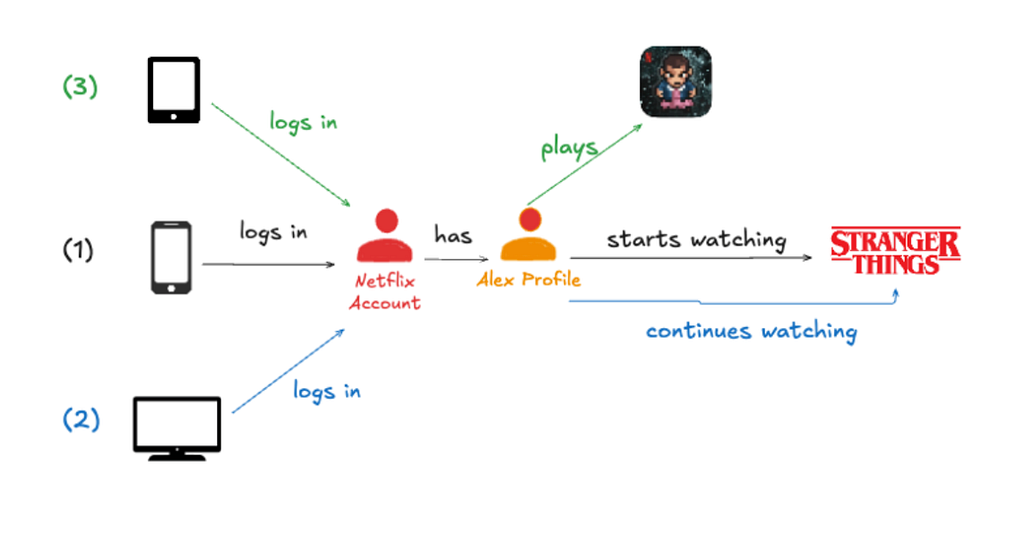 How and Why Netflix Built a Real-Time Distributed Graph: Part 3 — Querying the graph with gRPC…How and Why Netflix Built a Real-Time Distributed Graph: Part 3 — Querying the graph with gRPC execution API Authors: Nilesh Mishra and Ajit Koti This is the third entry of a multi-part blog series describing how we built a Real-Time Distributed Graph (RDG). In Part 1 , we discussed the motivation for creating the RDG and the architecture of the data processing pipeline that populates it. In Part 2 , we discussed how we designed the storage layer to handle billions of nodes and edges while maintNetflix Technology Blog